A best API search company’s homepage shows five things within the first screen: a clear value proposition, transparent pricing, working code samples, a live sandbox, and verifiable performance data. A homepage that hides any of these behind a sales call or a vague feature list signals friction that will show up again later in the integration process.
This guide breaks down what to check on a provider’s homepage before signing up, then compares how the leading search API companies actually perform on pricing, speed, and reliability as of 2026.
Why the Homepage Matters Before the API Does
A developer evaluating a search API rarely starts with a sales conversation. They start with a homepage, and they decide whether to keep reading within seconds.
Research on page load behavior consistently shows that a site loading in one second converts at roughly three times the rate of a site taking five seconds, and a delay of just 100 milliseconds can reduce conversions by around 7%.
For an API provider, a slow or vague homepage does not just cost a visitor. It signals that the underlying infrastructure might behave the same way under load.
The homepage is also the fastest way to filter out providers that are not a technical fit. A page that leads with documentation and a working code sample respects a developer’s time. A page that leads with a demo request form does not.
Five Elements a Strong API Search Homepage Includes
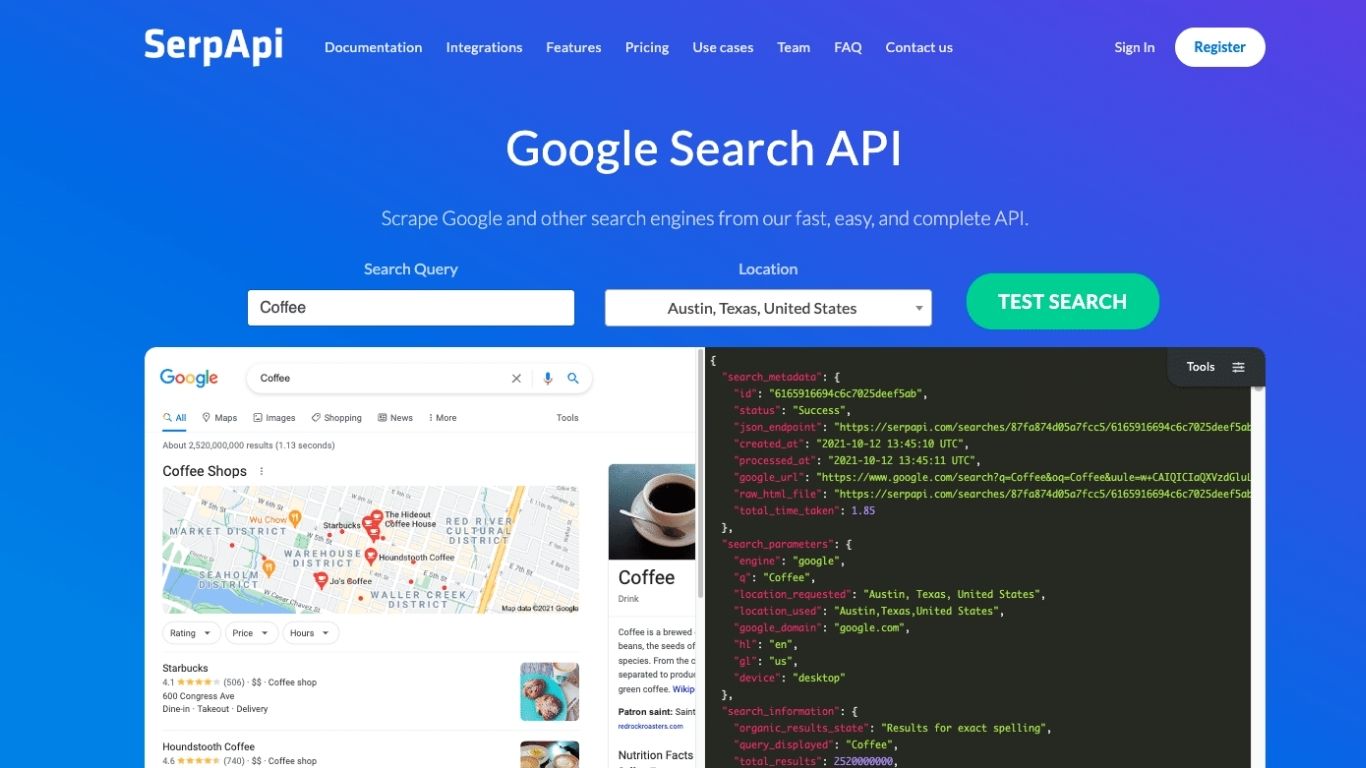
- A specific value proposition. The strongest homepages state exactly what kind of search they provide in the first sentence: SERP data, semantic search, site search, or company data. Vague language like “powerful search for everyone” forces the visitor to keep digging for the actual scope of the product.
- Transparent, tiered pricing. Pricing should be visible without a login, broken into a free tier, one or two mid-range tiers, and an enterprise tier with a stated starting range. Providers that hide pricing behind a “contact sales” button add friction that pushes evaluators toward a competitor with visible numbers.
- Working code samples above the fold. A homepage or an immediately linked quick-start page should show a real request and a real response, not a marketing screenshot. SDK coverage for Python, JavaScript, and Go signals broad compatibility with common agent and backend stacks.
- A live sandbox or interactive demo. Letting a developer run a real query before creating an account shortens the evaluation cycle. Platforms with an interactive trial typically see meaningfully higher demo completion rates than those requiring signup first.
- Verifiable reliability data. A homepage or status page that publishes uptime SLAs, P99 latency figures, and (for scraping-adjacent search APIs) anti-bot success rates gives a technical buyer something to check against, rather than something to take on faith.
| Homepage element | What it should show | Red flag |
| Value proposition | One clear search category | Generic “powerful search” language |
| Pricing | Visible tiers with numbers | “Contact us” with no range |
| Code samples | Real request and response | Screenshot only, no live example |
| Sandbox | Query testing without signup | Demo request form only |
| Reliability data | Published uptime, latency, SLA | No status page or benchmarks |
What Changed in the Search API Market in 2026
The category shifted meaningfully in the first half of 2026, and any homepage comparison built on older data will be inaccurate on at least three points.
Brave Search API removed its perpetual free tier in February 2026, replacing it with a $5 monthly credit per plan rather than an unlimited free allotment. Anyone comparing free-tier depth against older reviews should verify this directly on Brave’s current pricing page.
Tavily was acquired by Nebius in February 2026 and continues to operate under its own brand, but ownership changes like this are worth tracking for anyone building a long-term dependency on the platform’s roadmap.
Google filed suit against SerpAPI on December 19, 2025, an ongoing matter that adds legal uncertainty for any provider whose data pipeline depends on scraping Google’s search results at scale.
API Search Providers Compared: Pricing and Performance
The table below reflects publicly listed 2026 pricing. Rates change frequently in this category, so treat this as a starting comparison and verify current numbers directly before committing to a plan.
| Provider | Free tier | Paid entry price | Best fit |
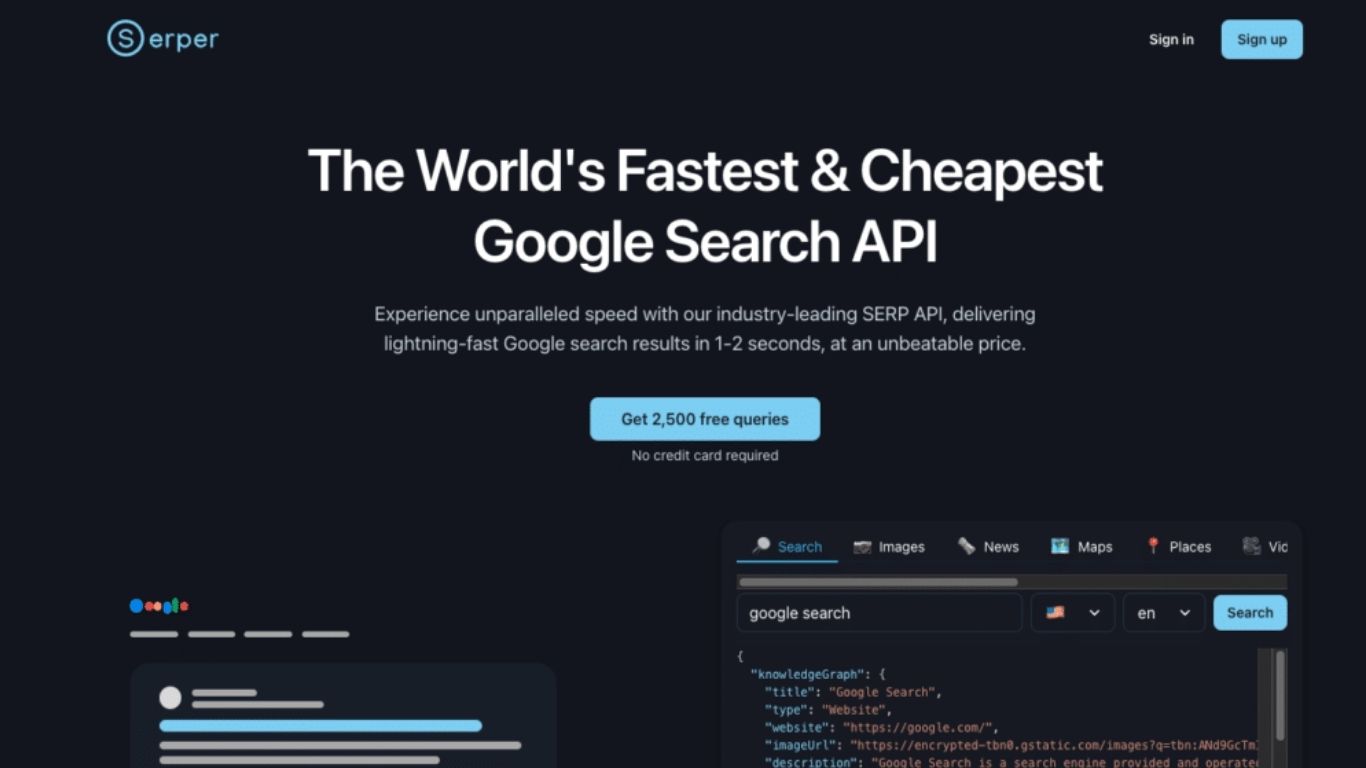
| Serper | 2,500 queries, one-time | $1.00 per 1,000 queries (Starter), down to $0.30 per 1,000 at scale | Raw Google SERP data at the lowest cost per query |
| Brave Search API | $5 monthly credit (as of Feb 2026) | $5.00 per 1,000 queries | Privacy-focused, independent index, zero data retention |
| Tavily | 1,000 credits monthly | Roughly $7.50 to $8.00 per 1,000 basic searches | Agent-optimized search with built-in content extraction |
| Exa | 20,000 requests monthly | $7.00 per 1,000 search requests | Semantic and neural search, research and discovery use cases |
| SerpAPI | 250 searches | Around $75 per month for 5,000 searches | Multi-engine coverage with Maps, Shopping, and Knowledge Graph data |
| Firecrawl | 500 credits, one-time | $16 per month for 3,000 credits | LLM-ready markdown extraction for RAG pipelines |
How to Read Response Time Claims Correctly
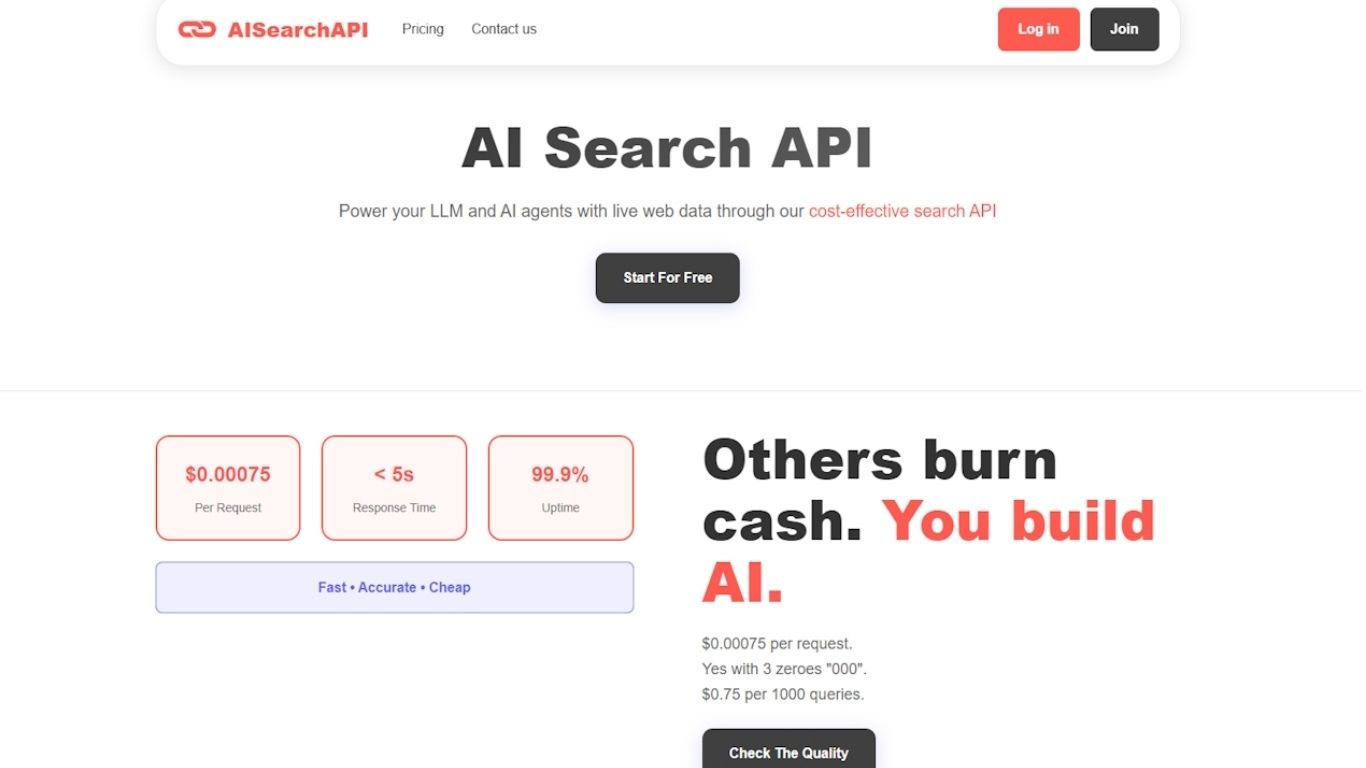
Most homepage speed claims quote an average response time, which hides the outliers that actually break a production system. A more reliable way to evaluate a provider is to ask for percentile data instead of averages.
P50 (median) shows the typical response time a request experiences under normal load.
P99 shows the worst 1% of requests, which is the number that actually determines whether a real-time application feels reliable. A provider quoting only a fast average while avoiding P99 figures is a homepage worth double-checking through independent testing rather than trusting outright.
For most production search integrations, a P50 between 200ms and 500ms is workable, while anything regularly exceeding 2 seconds at P99 will be noticeable to end users in a live application.
A Practical Checklist Before Choosing a Provider
- Confirm the current free tier limit directly on the provider’s pricing page, since several major providers changed their free-tier structure in 2026.
- Request P99 latency data, not just an advertised average, especially for any application with real-time user-facing search.
- Check for a published status page with historical uptime, not just a claimed SLA percentage in marketing copy.
- Test the sandbox with a real query relevant to your use case, not the pre-filled example query most demos default to.
- Calculate cost at your actual expected volume, since per-query rates often drop sharply at higher tiers and a provider that looks expensive at 1,000 queries can be the cheapest option at 500,000.
- Verify SDK support for your specific stack rather than assuming broad language coverage from a homepage badge.
Conclusion
The best API search company’s homepage does the evaluation work for a developer instead of adding to it. It states exactly what kind of search the platform provides, shows real pricing without a sales call, and backs performance claims with data a visitor can verify independently, not just an average response time buried in marketing copy.
The market moved quickly through 2026, with Brave’s free tier changing, Tavily changing ownership, and a legal dispute affecting one of the largest SERP data providers, which makes homepage-level pricing and performance claims a starting point rather than a final answer.
Confirm the numbers directly on each provider’s current pricing page, request percentile latency data instead of averages, and test the sandbox with a query from your own use case before committing to any plan.
Frequently Asked Questions
What makes an API search company’s homepage trustworthy?
A trustworthy homepage shows visible pricing tiers, working code samples, a live sandbox for testing, and published reliability data such as uptime SLAs and latency percentiles.
Which search API has the largest free tier in 2026?
Exa currently offers 20,000 free search requests per month, the largest free allotment among major search API providers.
Is average response time a reliable metric for choosing a search API?
No. Average response time hides worst-case performance. P99 latency, which reflects the slowest 1% of requests, gives a more accurate picture of real-world reliability.
Did Brave Search API remove its free tier?
Brave replaced its perpetual free tier with a $5 monthly credit per plan starting in February 2026, rather than removing free access entirely.
What is the cheapest search API for raw Google SERP data?
SerpAPI offers the lowest per-query cost for raw Google SERP data, starting at $1.00 per 1,000 queries and dropping to $0.30 per 1,000 at higher volumes.
Why does the SerpAPI lawsuit matter for developers?
Google filed suit against SerpAPI in December 2025 over its scraping practices. Any application built on scraped Google SERP data carries some legal and continuity risk tied to that dispute.