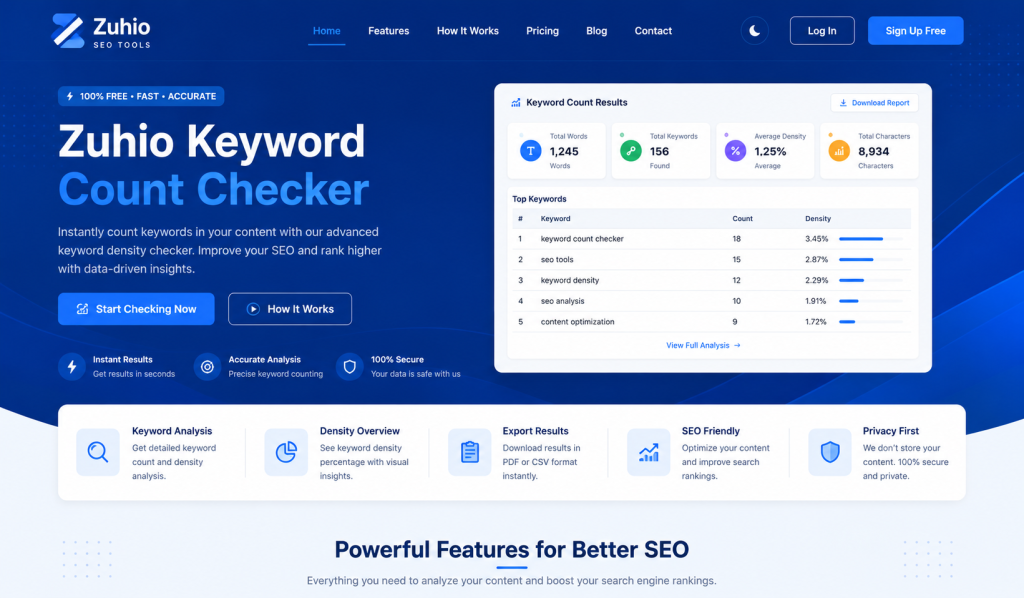
The Zuhio Keyword Count Checker is a web-based tool that scans a piece of pasted content and reports how many times a specific keyword appears, along with that count expressed as a percentage of total word count. It measures keyword frequency and density only. It does not audit technical SEO factors, crawl live websites, or analyze backlinks.
This guide covers what the tool measures, how the density formula works, its scope and limitations, how to interpret the results, and how it compares to broader SEO platforms.
What the Zuhio Keyword Count Checker Measures
The tool performs two calculations on any block of text submitted to it.
| Output | Definition |
| Keyword frequency | The raw number of times the target keyword or phrase appears in the text |
| Keyword density | Keyword frequency divided by total word count, expressed as a percentage |
The density formula:
Keyword Density = (Keyword Occurrences ÷ Total Word Count) × 100
A keyword that appears 12 times in a 1,000-word article produces a density of 1.2%.
What the Tool Does Not Do
Understanding the tool’s boundaries prevents it from being mistaken for a full SEO audit platform.
- Does not crawl or analyze a live webpage
- Does not evaluate title tags, meta descriptions, or structured data
- Does not check backlinks or domain authority
- Does not pull keyword search volume or competition data
- Does not suggest new content topics
The tool is limited by design to one function: measuring how often a keyword appears in submitted text and calculating that as a percentage.
Why Keyword Frequency Still Gets Checked
Search engines evaluate content to determine topical relevance. A keyword that never appears in a lengthy article makes it harder for a search engine to confirm the page addresses that topic directly. The inverse also holds: a keyword repeated at an artificially high rate reads as manipulative to both readers and ranking algorithms.
Keyword frequency is not treated as a direct, standalone ranking factor by modern search engines, which place more weight on semantic relevance, search intent alignment, and content depth. Checking frequency remains useful as an editing step, specifically to catch two common issues.
- Accidental omission. A keyword the writer intended to target does not appear enough for the topic to read as clearly relevant.
- Unintentional overuse. A keyword repeated so often that sentences become mechanical or repetitive.
Keyword placement in specific high-visibility locations, including the title, the opening paragraph, and at least one heading, generally carries more weight than total volume spread through the body of an article.
Recommended Keyword Frequency by Content Length
The table below outlines commonly referenced starting points for keyword frequency at different content lengths. These figures function as general guidelines rather than fixed requirements, since content type, niche, and competition level all affect what reads as natural.
| Content Length | Suggested Mentions | Approximate Density |
| 500 words | 5 to 8 | 1.0% to 1.6% |
| 1,000 words | 10 to 15 | 1.0% to 1.5% |
| 1,500 words | 15 to 22 | 1.0% to 1.5% |
| 2,000 words | 20 to 30 | 1.0% to 1.5% |
Interpreting Keyword Density Results
| Density Range | Interpretation |
| Below 1% | May not signal clear topical relevance, particularly in longer content |
| 1% to 2% | Commonly cited as a reasonable working range for most content types |
| 2% to 3% | Approaching a level that can read as repetitive |
| Above 3% | Frequently associated with over-optimization and reduced readability |
Density figures function as a comfort zone rather than a hard threshold. A page can rank well outside these ranges if the surrounding content is thorough and directly answers the search intent behind the keyword, and a page can underperform within these ranges if the content lacks depth.
How to Use the Zuhio Keyword Count Checker
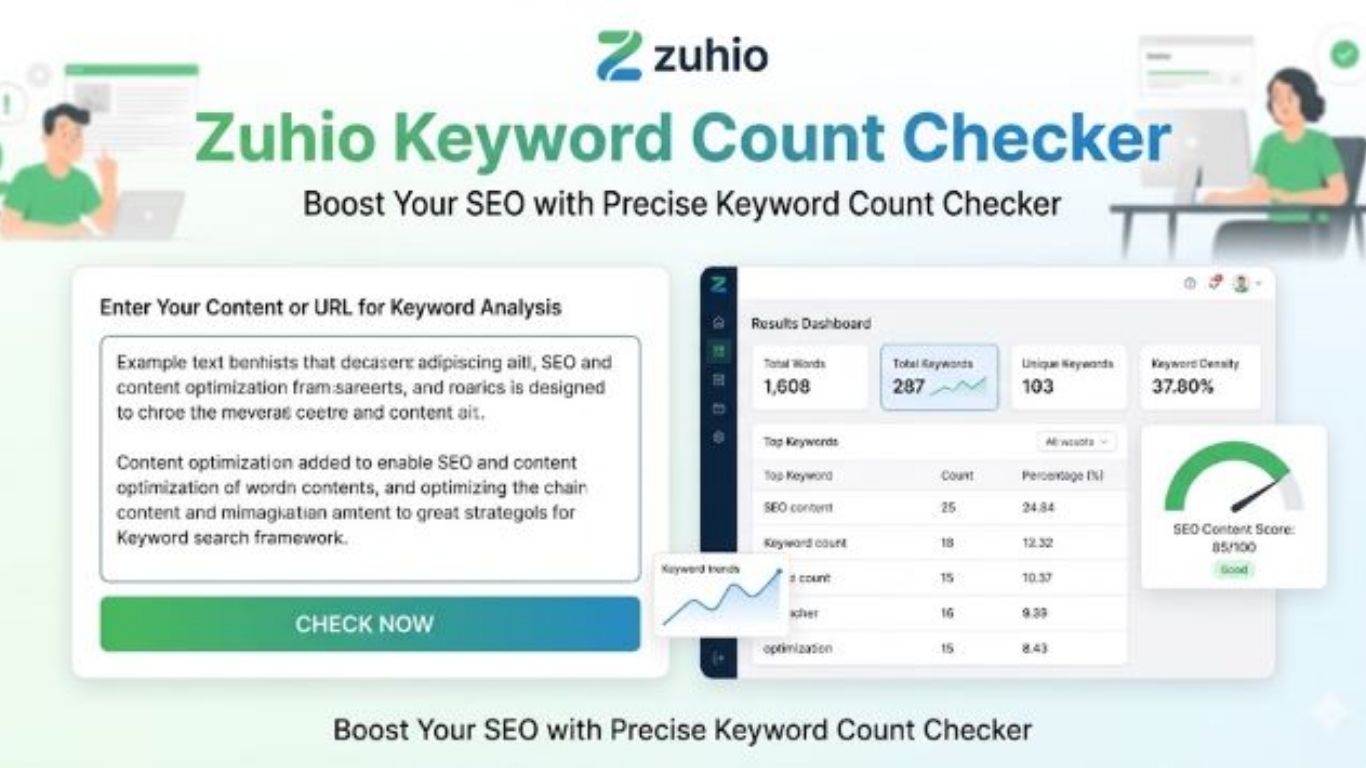
- Open the tool and paste content. Copy the full draft, or the specific section under review, into the text field.
- Enter the target keyword. Type the exact keyword or phrase to be measured.
- Run the analysis. The tool scans the text and returns the frequency and density figures.
- Review the output. Note the keyword count, the density percentage, and where in the content the keyword is concentrated.
- Adjust the content based on the data. Add the keyword where it fits naturally if density is low, or replace some instances with synonyms if density is high.
Best Practices When Using a Keyword Frequency Tool
- Write before checking. Drafting content around a target density tends to produce forced, repetitive sentences. Writing naturally first and reviewing frequency afterward generally produces better results.
- Use variations alongside the exact phrase. Related terms and synonyms support topical relevance without relying entirely on one repeated phrase.
- Prioritize placement over volume. A keyword placed in the title, the first 100 words, and at least one subheading typically carries more weight than the same keyword repeated many times through the body text.
- Treat the density figure as one input, not a target. Content quality, clarity, and alignment with what the reader is searching for remain the primary factors in how a page performs.
Common Mistakes When Using Keyword Count Data
- Inserting keywords after seeing a low count. If content already reads clearly and covers the topic in depth, forcing in extra mentions of the exact phrase usually reduces readability without a corresponding SEO benefit.
- Prioritizing density over readability. A sentence structured around fitting in a keyword rather than around clear meaning is noticeable to readers.
- Relying only on the exact-match phrase. Content that repeats one phrase while ignoring natural synonyms misses semantic signals that support topical relevance.
- Treating the result as a final SEO verdict. Keyword frequency is one data point among many, including content depth, page experience, and backlink profile, that affect how a page ranks.
Zuhio Keyword Count Checker Compared to Other SEO Tools
| Tool | Primary Function | Complexity | Best Suited For |
| Zuhio Keyword Count Checker | Keyword frequency and density | Very simple | Quick content checks before publishing |
| Yoast SEO | On-page SEO for WordPress | Moderate | WordPress-based content optimization |
| Ahrefs | Full SEO research suite | Advanced | Keyword research, backlink analysis, site audits |
| SEMrush | Digital marketing platform | Advanced | Competitive analysis and full campaign management |
| General-purpose SEO utilities | Basic SEO checks | Simple | Lightweight, single-purpose SEO tasks |
The Zuhio Keyword Count Checker occupies the simplest end of this spectrum. It performs one function without the setup, account creation, or learning curve associated with full-featured SEO platforms, which makes it useful for a quick check but insufficient as a standalone SEO strategy tool.
Who the Tool Is Useful For
- Bloggers confirming keyword placement in long-form posts before publishing
- SEO specialists running a quick content check without opening a full platform
- Copywriters verifying that a focus keyword has not been accidentally overused in short landing page copy
- Independent website owners managing content without access to enterprise SEO software
- Editors performing a final review pass on drafts before they go live
Frequently Asked Questions
What does the Zuhio Keyword Count Checker measure?
It measures how many times a specific keyword appears in pasted content and calculates that count as a percentage of the total word count, known as keyword density.
Does the tool analyze technical SEO factors?
No. It does not crawl live websites, evaluate meta tags, check backlinks, or assess any technical SEO element. It measures keyword frequency in submitted text only.
What is considered a reasonable keyword density?
A density between 1% and 2% is commonly cited as a working range for most content types, though the appropriate figure varies with content length, niche, and competition.
Can keyword stuffing affect search rankings?
Yes. Search engine guidelines identify keyword stuffing as a practice that can negatively affect rankings, and excessive repetition also reduces readability, which affects how visitors engage with a page.
Is the tool suitable for beginners?
Yes. The workflow requires no technical setup. Content is pasted, a keyword is entered, and results appear immediately, with no SEO background required.
Does keyword count alone determine how well a page ranks?
No. Keyword count is one signal among many. Content quality, semantic relevance, search intent alignment, and off-page factors such as backlinks all contribute to ranking performance.
How is this tool different from a full SEO platform like Ahrefs or SEMrush?
The Zuhio Keyword Count Checker performs a single function, keyword frequency and density measurement, while full SEO platforms combine keyword research, backlink analysis, technical audits, and competitive tracking in one system.
This article is an independent, informational overview of the Zuhio Keyword Count Checker based on publicly available information. It is not affiliated with Zuhio. Readers should verify current tool features directly before relying on it for content decisions.