What Is a Content Roadmap?
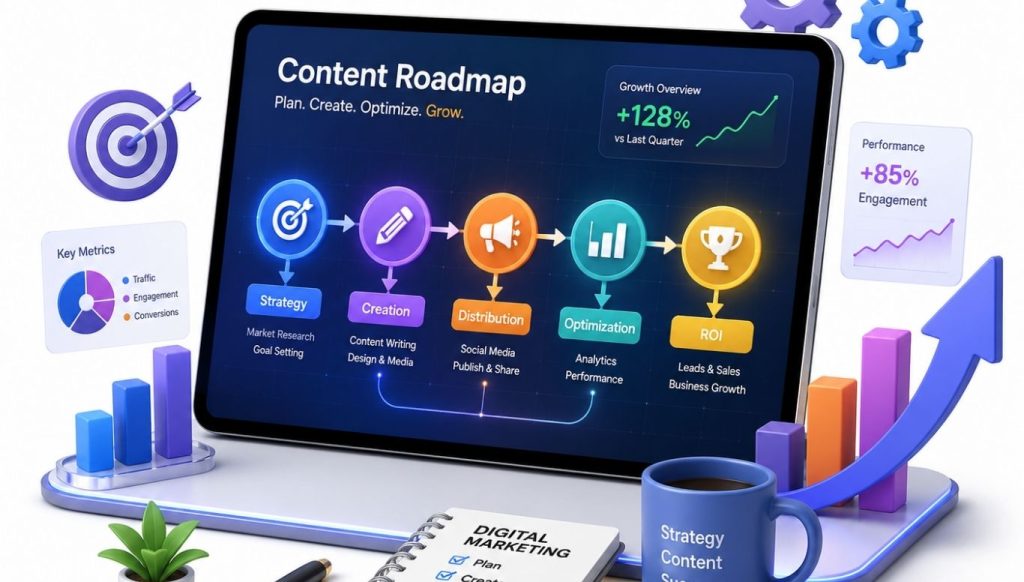
A content roadmap is a high-level plan that connects each content topic to a specific business goal and a stage of the buyer journey. It lists what content a team will create, why each piece exists, and which outcome it supports. It does not include publish dates, word counts, or channel-by-channel schedules; that level of detail belongs on a content calendar.
A content roadmap typically spans one quarter to one year. It groups topics under content pillars, assigns each pillar to a funnel stage (awareness, consideration, decision), and attaches a success metric to each group.
Teams that publish without a roadmap waste budget on pages that never rank and never convert. A roadmap removes that risk before the first draft starts.
At Domain Age Checker, every new tool page, guide, and blog post traces back to a gap identified through the site’s own Content Quality Checker and On-Page SEO Analyzer.
This process, structured as a content marketing roadmap, keeps publishing decisions tied to actual search demand rather than guesswork.
Content Roadmap vs. Content Calendar
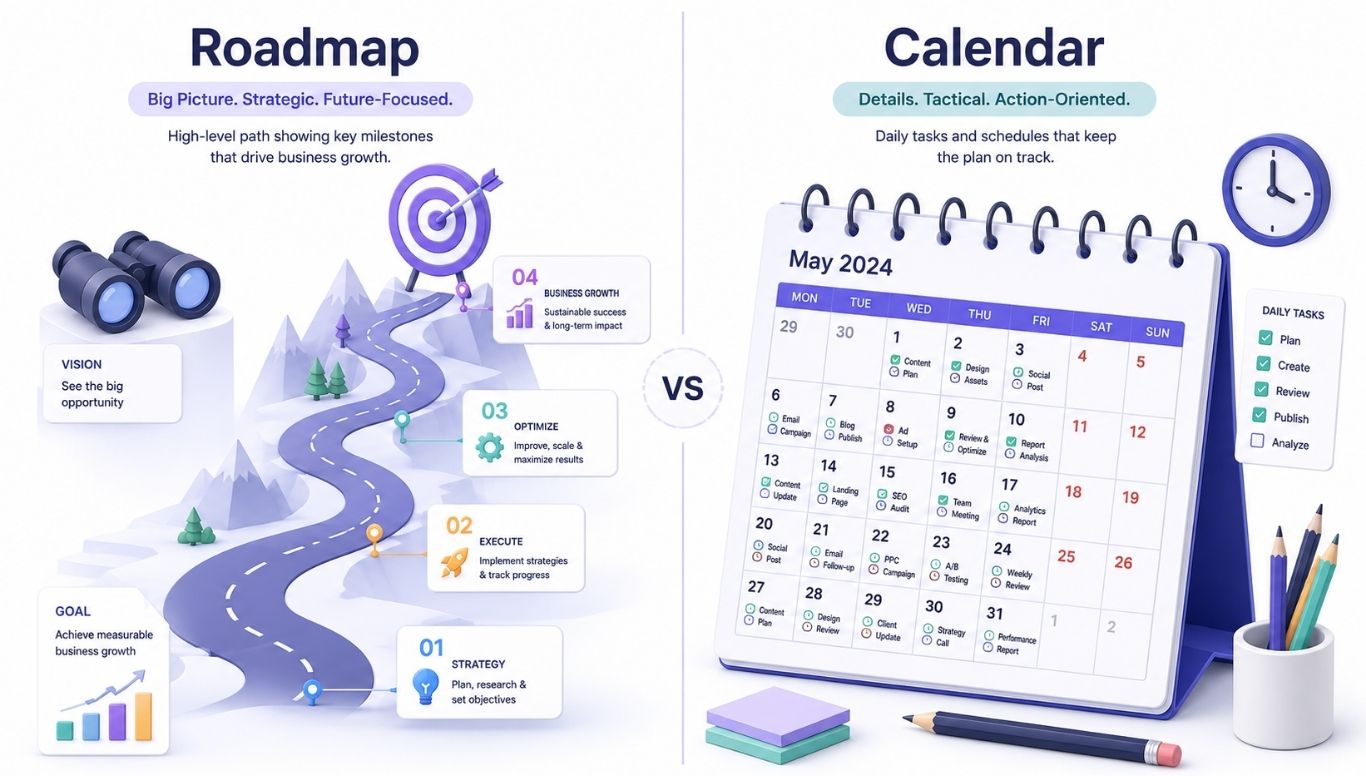
A content roadmap and a content calendar serve different functions. Confusing the two produces either a plan with no execution detail or a schedule with no strategic direction.
| Element | Content Roadmap | Content Calendar |
|---|---|---|
| Scope | Quarterly or annual | Weekly or monthly |
| Focus | Goals, pillars, funnel stages | Publish dates, authors, channels |
| Detail level | High-level | Task-level |
| Owner | Content strategist or marketing lead | Content or editorial manager |
| Changes frequency | Reviewed monthly or quarterly | Updated weekly |
A content strategy roadmap sits above both documents. It defines the audience, brand voice, and long-term positioning that the roadmap and calendar then execute against.
Content Roadmap Example
The table below shows a sample content roadmap for a SaaS company targeting three funnel stages over one quarter.
| Content Pillar | Funnel Stage | Content Type | Target Metric | Owner |
|---|---|---|---|---|
| Onboarding best practices | Awareness | Blog post | 500 organic sessions/month | Content writer |
| Product vs. competitor X | Consideration | Comparison guide | Top 5 ranking, 8% CTR | Content writer + SEO lead |
| Free trial signup guide | Decision | Landing page | 3% conversion rate | Product marketer |
| Customer case study series | Decision | Case study | 20 qualified leads/quarter | Content writer |
Each row ties a topic to one funnel stage and one measurable target, which is what separates a roadmap entry from a random blog idea.
Content Roadmap Template Components
A reusable content roadmap template contains five fields per row: topic, funnel stage, target keyword, target metric, and owner. Marketing teams typically build this template in a spreadsheet with one tab per quarter, or in project management software that supports timeline and Kanban views.
Content Marketing Institute’s 2024 B2B benchmark report, based on 894 B2B marketer responses, found that a documented strategy is one of the factors top-performing content teams cite most often for their success, alongside audience research and goal alignment with business objectives.
A documented roadmap is the operational layer that makes a documented strategy executable week to week.
Why a Content Roadmap Matters
A content roadmap produces five measurable outcomes for a content team.
- It prevents duplicate content. Teams without a roadmap often publish two pages targeting the same keyword. A roadmap forces a gap check before writing starts.
- It ties content to revenue. Each roadmap entry maps to a goal such as lead generation, organic traffic, or retention, which makes ROI reporting direct.
- It aligns cross-functional teams. Sales and product teams can see upcoming content and prepare campaigns or launches around it.
- It builds topical authority. Search engines rank sites higher when they cover a topic in depth through connected content clusters.
- It simplifies reporting. Every roadmap item has a defined metric, so performance review requires no separate goal-setting step.
What a Content Roadmap Should Include
A complete content roadmap contains eight components.
- Target audience: buyer personas mapped to pain points at each funnel stage. Example: a first-time buyer researching options versus a returning customer comparing plans.
- Business objectives: the measurable outcome for the content set, such as organic traffic growth or lead capture.
- Content pillars: the core topics the brand owns in search results. Example pillars: “content strategy,” “keyword research,” “on-page SEO.”
- Content types: the formats used to cover each pillar. Example types: blog posts, comparison guides, calculators, case studies.
- Distribution channels: the platforms where content will be published or promoted. Example channels: owned website, email newsletter, and partner sites.
- Milestones: checkpoints such as first draft, review, publish date, and 30-day performance review.
- Owners: the person responsible for writing, editing, and approving each piece.
- Success metrics: the specific number tracked per goal. Example metrics: keyword ranking position, organic sessions, conversion rate, referring domains.
How to Build a Content Roadmap in 7 Steps

- Set the objective. Define the single business outcome the roadmap must support, such as a 20% increase in organic sessions within two quarters.
- Audit existing content. Sort every published page into three groups: keep as-is, needs update, remove or merge. Score each page with a content quality and readability tool, then compare scores against the top-performing pages on the site.
- Research audience and keywords. Build a keyword list with search volume, ranking difficulty, and current position for each term.
- Identify content gaps. Compare the keyword list against the audit results. A gap exists where a valuable keyword has no matching page or where an existing page ranks below position 10.
- Organize by funnel stage. Assign each topic to awareness, consideration, or decision. A roadmap weighted only toward awareness content rarely produces conversions.
- Assign timelines and owners. Set deadlines for research, drafting, editing, and publishing, and name one owner per stage.
- Review on a fixed schedule. Revisit the roadmap monthly or quarterly and adjust based on ranking changes, new keyword opportunities, or shifted business priorities.
How to Prioritize Topics on a Content Roadmap
A roadmap with fifty potential topics needs a scoring method, not a gut decision. Two frameworks adapted from product management work well for content prioritization.
ICE Scoring for Content
ICE scores each topic on three factors, each rated 1 to 10:
| Factor | Question It Answers |
|---|---|
| Impact | How much will this topic move the target metric if it succeeds? |
| Confidence | How certain is the team that this topic will rank and convert? |
| Ease | How much time and resource does this topic require? |
Multiply the three scores and rank topics by the total. A topic scoring 8 (impact) × 7 (confidence) × 9 (ease) = 504 outranks a topic scoring 9 × 9 × 3 = 243, even though the second topic looks more valuable on impact alone.
RICE Scoring for Content
RICE adds a reach factor: (Reach × Impact × Confidence) ÷ Effort. Reach is the estimated monthly search volume or audience size for the topic, and effort is the estimated hours or days to produce and optimize the piece. RICE works better than ICE for larger roadmaps because it accounts for how many people a topic can actually reach, not just how well it might convert.
Teams should pick one method and apply it consistently across every roadmap review, since scores are only comparable when the scoring criteria stay fixed quarter to quarter.
Content Roadmap KPIs by Funnel Stage
Different funnel stages call for different success metrics. Attaching the wrong metric to a stage is a common reason roadmap items get marked “failed” when they actually worked as intended.
| Funnel Stage | Primary KPI | Secondary KPI | Typical Review Window |
|---|---|---|---|
| Awareness | Organic sessions | Keyword ranking position | 90 days |
| Consideration | Click-through rate, time on page | Ranking for comparison terms | 60 days |
| Decision | Conversion rate | Qualified leads generated | 30 days |
| Retention (post-purchase) | Repeat visits, feature adoption | Support ticket deflection | 90 days |
An awareness-stage blog post should not be judged by conversion rate at 30 days; it has not had time to build the organic traffic that makes conversion possible.
Content Roadmap Tools Compared
| Tool Type | Best For | Limitation |
|---|---|---|
| Spreadsheet (Google Sheets, Excel) | Solo creators and small teams | No built-in timeline or Kanban view |
| Project management software (Asana, Monday, ClickUp) | Cross-functional teams with non-content stakeholders | Requires setup time to build a content-specific template |
| Dedicated roadmap software (Productboard, airfocus) | Teams that already run product roadmaps and want content aligned to the same system | Higher cost, steeper learning curve for content-only teams |
| SEO-integrated planning tools | Teams that want gap analysis and roadmap building in one workflow | Fewer options built specifically for content roadmaps rather than product roadmaps |
Most single-person or small-agency content operations do not need dedicated roadmap software. A structured spreadsheet with the five template fields covers the same function without added cost.
How a Content Roadmap Supports Topical Authority
A roadmap built around isolated keywords produces scattered pages. A roadmap built around content pillars produces topic clusters, and topic clusters are what search engines use to judge how completely a site covers a subject.
Each pillar on a roadmap should link to a small set of supporting pages that cover subtopics, comparisons, and definitions related to the pillar. Internal links between the pillar page and its supporting pages signal the relationship to search engines and keep readers moving through related content instead of leaving after one page.
Teams building a roadmap around single keywords instead of pillars often end up with several pages competing against each other for the same search term, which weakens rather than strengthens topical authority.
Common Content Roadmap Mistakes
- Over-detailing the roadmap. Listing exact publish times for individual social posts turns a roadmap into a calendar.
- Skipping the content audit. This produces duplicate or competing pages targeting the same keyword.
- Ignoring search intent. A keyword with high search volume produces no value if the page format does not match what users expect to see.
- Treating the roadmap as static. A roadmap set once and never revisited goes stale as rankings, algorithms, and audience needs shift.
- Leaving out success metrics. A roadmap item with no attached metric cannot be evaluated for success or failure.
- Scoring every topic the same way regardless of team size. A five-person content team and a solo creator need different prioritization thresholds; applying enterprise-scale scoring criteria to a one-person roadmap slows down publishing without adding accuracy.
FAQs About Content Roadmaps
What is a content roadmap in simple terms?
A content roadmap is a high-level plan that lists what content a team will create and which business goal each piece supports.
How is a content roadmap different from a content strategy?
A content strategy defines audience, brand voice, and overall direction. A content roadmap converts that strategy into a timeline of topics and milestones.
How often should a content roadmap be updated?
A content roadmap should be reviewed monthly or quarterly, and sooner if a major keyword opportunity or ranking drop appears.
Do small businesses need a content roadmap?
Yes. A single content creator benefits from mapping topics to goals, since it prevents time spent on posts that do not support growth.
What tools can build a content roadmap?
Spreadsheets work for small teams. Larger teams typically use project management software or dedicated roadmap tools that support timeline views and collaboration.
What is the difference between a content roadmap and a content calendar?
A content roadmap covers goals, pillars, and milestones. A content calendar covers exact publish dates, authors, and channel assignments for each piece.
What is the first step in building a content roadmap?
The first step is setting a clear business objective, since every topic on the roadmap must trace back to that goal.
How many content pillars should a roadmap have?
Most roadmaps use three to five content pillars, each broad enough to support multiple subtopics but narrow enough to maintain topical focus.
What is a content gap analysis?
A content gap analysis compares a keyword list against existing published content to find valuable search terms with no matching page or with a page ranking below position 10.
Should a content roadmap include underperforming pages?
Yes. Underperforming pages identified in a content audit should appear on the roadmap as “update” or “merge” items, not only new topics.
What metrics belong on a content roadmap?
Common metrics include keyword ranking position, organic sessions, conversion rate, and referring domains, matched to the objective of each content pillar.
Can a content roadmap change mid-quarter?
Yes. A roadmap should adjust when performance data, algorithm updates, or new keyword opportunities change the original assumptions.
How do you prioritize which topics go on the roadmap first?
Score each candidate topic using a framework such as ICE (impact, confidence, ease) or RICE (reach, impact, confidence, effort), then rank topics by total score rather than by instinct alone.
Conclusion
A content roadmap connects every piece of content a team produces to a specific business goal and funnel stage, without getting into the publish-date detail that belongs on a content calendar.
Building one requires setting an objective, auditing existing content, finding keyword gaps, organizing topics by funnel stage, and reviewing the plan on a fixed schedule.
Adding a scoring framework such as ICE or RICE and matching KPIs to each funnel stage removes the guesswork from deciding what to publish next and how to judge whether it worked.
Key Takeaways
- A content roadmap is a high-level, quarterly-to-annual plan connecting content topics to business goals and funnel stages.
- It differs from a content calendar, which covers exact publish dates, authors, and channels.
- A complete roadmap includes eight components: audience, objectives, pillars, content types, channels, milestones, owners, and metrics.
- ICE and RICE scoring frameworks give teams a repeatable way to prioritize which topics get built first.
- KPIs should match the funnel stage: organic sessions for awareness, click-through rate for consideration, conversion rate for decision.
- Spreadsheets are sufficient for most small teams; dedicated roadmap software suits larger, cross-functional operations.
- Organizing a roadmap around content pillars rather than isolated keywords builds topical authority and prevents pages from competing against each other.