Cloud application development services design, build, deploy, and maintain software applications that run on cloud infrastructure such as AWS, Microsoft Azure, and Google Cloud Platform instead of on-premises servers. These services cover the full application lifecycle: architecture planning, custom development, migration, integration, testing, and ongoing support. A cloud application stores data, runs logic, and serves users through remote servers, which removes the need for businesses to buy, host, or manage physical hardware.
Businesses use cloud application development to reduce infrastructure costs by up to 30-40%, scale resources on demand, and deploy updates faster than traditional on-premises software. According to a 2023 Flexera State of the Cloud report, 89% of enterprises now operate a multi-cloud strategy, using more than one cloud provider to run production applications.
What Is a Cloud Application?
A cloud application is a software program whose computing and storage components run on remote servers accessed over the internet, rather than on a user’s local device or a company’s own data center. Cloud applications rely on three core layers: front-end interfaces (web or mobile), back-end services hosted on cloud servers, and databases stored in cloud environments like Amazon RDS, Azure SQL, or Google Cloud Firestore.
Cloud applications differ from traditional desktop or on-premises applications in three measurable ways:
| Factor | Cloud Application | On-Premises Application |
|---|---|---|
| Server ownership | Rented from a cloud provider (AWS, Azure, GCP) | Owned and maintained by the business |
| Scaling method | Automatic, usage-based (autoscaling) | Manual hardware upgrades |
| Access | Any device with internet access | Limited to local network or VPN |
| Upfront cost | Low (pay-as-you-go) | High (hardware purchase) |
| Update cycle | Continuous deployment | Scheduled manual updates |
Core Cloud Application Development Services
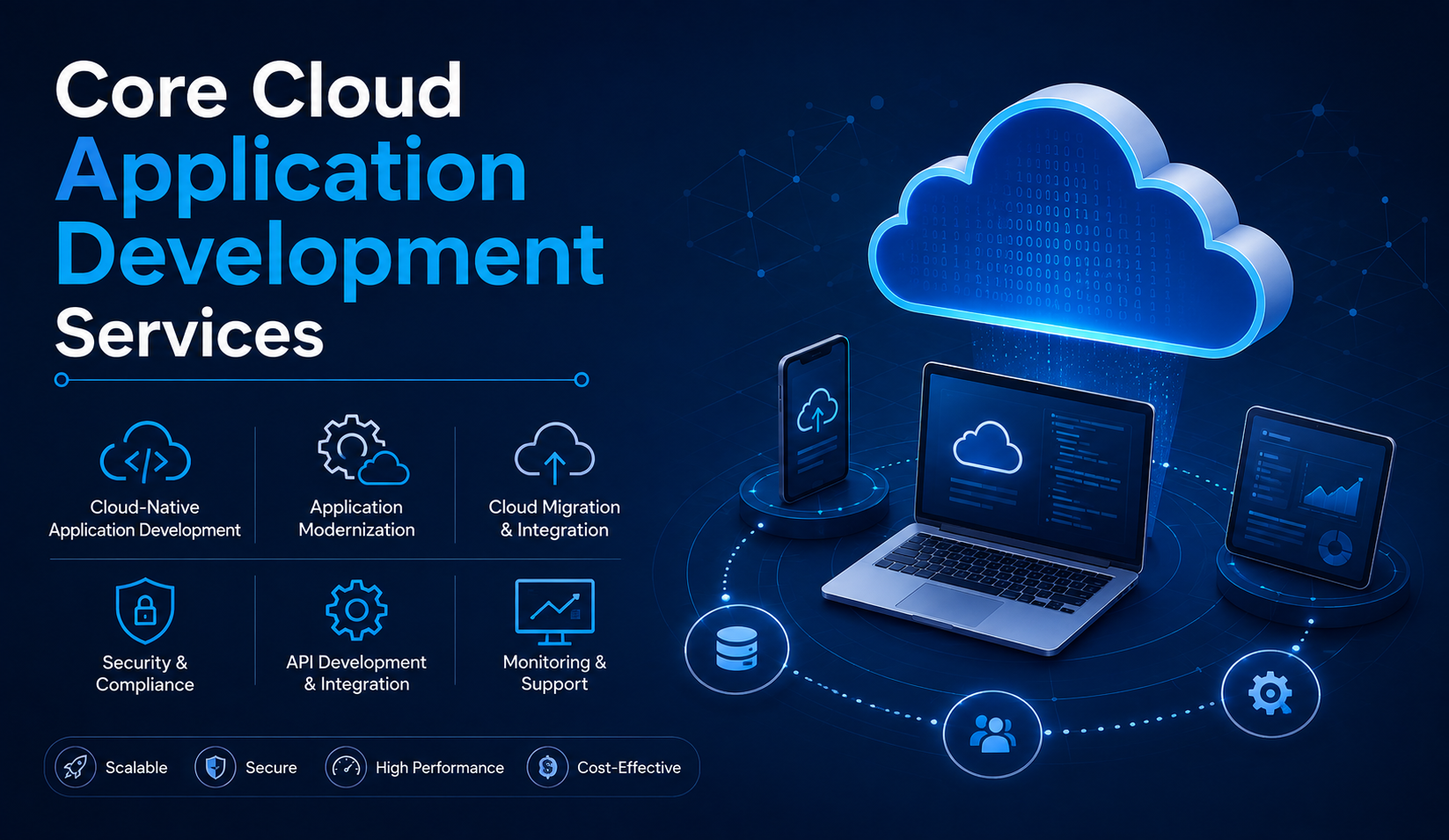
Cloud application development companies typically deliver six categories of service. Each category addresses a distinct stage of the application lifecycle.
1. Custom Cloud Application Development
Custom cloud application development builds software from the ground up to match specific business workflows, using cloud-native design patterns from the first line of code. This service includes requirement analysis, UI/UX design, back-end architecture, API development, and quality assurance. Custom builds suit businesses with workflows that off-the-shelf SaaS tools cannot support, such as logistics platforms, healthcare portals, or fintech dashboards.
2. Cloud-Native Application Development
Cloud-native development builds applications using microservices, containers, and serverless computing so that each application component scales and deploys independently. A microservice is a single, independently deployable function within an application, such as a payment processor or a notification service. Containers, most commonly built with Docker, package a microservice with its dependencies so it runs the same way across development, testing, and production environments. Kubernetes then manages and scales groups of containers automatically based on traffic.
3. Cloud Application Migration
Cloud application migration moves an existing on-premises or legacy application to a cloud environment. Migration follows one of four common strategies, known as the 4 R’s:
- Rehosting — moving the application to the cloud without changing its code, often called “lift and shift.”
- Replatforming — making small cloud-specific optimizations during the move, such as switching to a managed database.
- Refactoring — rewriting parts of the application to use cloud-native services like serverless functions.
- Rebuilding — redesigning the application from scratch using cloud-native architecture.
A 2022 Gartner study found that rehosting accounts for approximately 30% of enterprise cloud migrations because it delivers the fastest time-to-cloud with the lowest initial engineering effort.
4. Cloud Application Integration
Cloud integration connects a cloud application with other systems, such as CRMs, ERPs, payment gateways, and third-party APIs, so data moves between them without manual entry. Integration typically uses REST APIs, webhooks, or middleware platforms like MuleSoft or Zapier to synchronize data in real time.
5. Cloud Application Testing and Quality Assurance
Cloud application testing verifies functionality, performance, and security before and after deployment. This includes load testing (simulating high user traffic), security testing (identifying vulnerabilities), and integration testing (confirming connected systems exchange data correctly). Continuous testing is built into CI/CD pipelines so every code update is validated automatically before release.
6. Cloud Application Support and Maintenance
Support and maintenance services keep a cloud application running after launch. This includes 24/7 uptime monitoring, security patching, performance tuning, backup management, and disaster recovery planning. Providers typically define uptime commitments in a Service Level Agreement (SLA), with 99.9% uptime as a common industry benchmark.
Benefits of Cloud Application Development
Cloud application development delivers five measurable benefits over traditional software development:
- Lower infrastructure costs. Pay-as-you-go pricing removes upfront hardware spending and charges only for resources used.
- Automatic scalability. Cloud platforms add or remove server capacity based on real-time traffic, without manual intervention.
- Faster deployment cycles. CI/CD pipelines allow teams to release updates multiple times per day instead of following quarterly release schedules.
- Built-in disaster recovery. Cloud providers replicate data across multiple physical data centers, reducing the risk of permanent data loss.
- Global accessibility. Applications remain accessible from any location or device with an internet connection, supporting remote and distributed teams.
Must Read: Search Engine Optimization Services for Small Business 2026
Cloud Application Development Process
A cloud application development company follows a structured process to move from concept to a live, maintained application.
- Discovery and requirement analysis. The development team gathers business requirements, defines the target users, and documents functional specifications.
- Architecture and cloud platform selection. The team selects a cloud provider (AWS, Azure, or Google Cloud) and designs the application architecture, including database structure and service components.
- UI/UX design. Designers create wireframes and interactive prototypes for developer and client review before coding begins.
- Development. Engineers write front-end and back-end code, build APIs, and configure cloud infrastructure using Infrastructure as Code tools such as Terraform.
- Testing. QA engineers run functional, performance, and security tests, including load testing to confirm the application performs under peak traffic.
- Deployment. The team releases the application to production using CI/CD pipelines, which automate build, test, and release steps.
- Monitoring and maintenance. The team tracks uptime, performance, and security post-launch, applying updates and patches on an ongoing basis.
Leading Cloud Platforms for Application Development
Three cloud platforms host the majority of enterprise cloud applications:
- Amazon Web Services (AWS) holds the largest cloud infrastructure market share, at approximately 31% as of Q2 2024, according to Synergy Research Group. AWS offers EC2 for compute, S3 for storage, and Lambda for serverless functions.
- Microsoft Azure holds approximately 25% of the cloud infrastructure market and integrates closely with Microsoft 365 and enterprise Windows environments.
- Google Cloud Platform (GCP) holds approximately 11% of the market and is commonly selected for applications built around data analytics and machine learning, using services like BigQuery and Vertex AI.
Read more: Best SEO Companies for Small Business (2026 Guide)
Cost Factors in Cloud Application Development
The cost of a cloud application depends on nine measurable factors:
- Number and complexity of application features
- Choice of cloud platform and pricing tier
- Number of user roles and permission levels
- Number of third-party integrations required
- Complexity of the database schema
- UI/UX design requirements, including custom animations
- Regulatory compliance needs, such as HIPAA or GDPR
- Development team location and hourly rate
- Ongoing maintenance and support scope
Simple cloud applications with a single core function typically range from $15,000 to $40,000 in development cost. Mid-complexity applications with multiple integrations and user roles range from $40,000 to $120,000. Enterprise-grade cloud platforms with custom architecture, compliance requirements, and AI features can exceed $150,000.
Industries That Use Cloud Application Development
Cloud application development supports application requirements across multiple industries, including:
- Healthcare (patient portals, telehealth platforms, HIPAA-compliant record systems)
- Finance and fintech (payment processing, digital banking, fraud detection dashboards)
- E-commerce (inventory management, order processing, customer-facing storefronts)
- Logistics (fleet tracking, warehouse management, route optimization)
- Education (learning management systems, virtual classrooms)
- Real estate (property management portals, listing platforms)
Cloud Application Development vs. Traditional Software Development
| Comparison Point | Cloud Application Development | Traditional Software Development |
|---|---|---|
| Deployment location | Cloud servers (AWS, Azure, GCP) | Local or on-premises servers |
| Initial cost | Low, subscription-based | High, hardware and licensing |
| Scalability | Automatic, on-demand | Manual, hardware-dependent |
| Maintenance | Managed by cloud provider and dev team | Fully managed in-house |
| Time to deploy | Days to weeks with CI/CD | Weeks to months |
Conclusion
Cloud application development services give businesses a structured path to build, migrate, and maintain applications on scalable, cost-efficient cloud infrastructure. The right approach depends on measurable factors: application complexity, cloud platform choice, integration needs, and compliance requirements.
Businesses that select a cloud application development company with proven experience across AWS, Azure, and Google Cloud reduce infrastructure costs, shorten deployment cycles, and gain the flexibility to scale as user demand grows.
Frequently Asked Questions
What are cloud application development services?
Cloud application development services cover the design, coding, testing, deployment, and maintenance of software applications built to run on cloud platforms such as AWS, Azure, or Google Cloud.
How much does cloud application development cost?
Cloud application development costs range from $15,000 for simple applications to over $150,000 for enterprise-grade platforms, depending on features, integrations, and compliance requirements.
How long does it take to build a cloud application?
A cloud application typically takes 3 to 9 months to build, depending on feature complexity, the number of integrations, and the size of the development team.
Is cloud application development secure?
Cloud application development is secure when it includes encryption, identity and access management, regular security audits, and compliance with standards such as SOC 2, HIPAA, or GDPR.
Can an existing application be migrated to the cloud?
Yes, existing applications can be migrated to the cloud using rehosting, replatforming, refactoring, or full rebuilding, depending on the application’s current architecture and target performance goals.
Which cloud platform is best for application development?
AWS suits general-purpose applications needing the widest service range, Azure suits enterprises using Microsoft infrastructure, and Google Cloud suits applications built around data analytics and machine learning.
Do cloud applications work without an internet connection?
Most cloud applications require an internet connection, though some use offline-first design with local data caching to provide limited functionality during connectivity loss.