The best SEO companies for small business deliver five specific capabilities: technical SEO, on-page optimization, local SEO, content production tied to search demand, and transparent reporting linked to leads or revenue. A qualified SEO company for a small business documents its process, shows verifiable results, and explains deliverables at every price tier rather than relying on ranking guarantees. Evaluating a provider against these five capabilities produces a more reliable comparison than relying on marketing claims alone.
Small businesses evaluating SEO companies face a wide range of pricing, specialization, and service models. A company strong in content production may lack technical depth. A company that runs standardized local SEO campaigns may not customize strategy for a competitive market. Comparing providers against a fixed set of criteria removes guesswork from the selection process.
What Makes an SEO Company Good for Small Business?
An SEO company qualifies as a strong fit for small business when it demonstrates capability across five weighted criteria: local SEO execution, technical SEO depth, content and on-page work, transparent reporting, and documented case results.
Local SEO Execution
Local SEO execution covers Google Business Profile optimization, citation management, and location-specific landing pages. A company serving small businesses should show examples of Local Pack rankings it has achieved for clients in comparable markets. Businesses without a strong local presence miss the map-pack traffic that drives a large share of small business leads.
Technical SEO Depth
Technical SEO depth includes Core Web Vitals optimization, structured data implementation, crawl error resolution, and site architecture review. A company should be able to explain, in specific terms, what a technical audit covers and how findings translate into prioritized fixes. Working with an organic SEO expert at the audit stage clarifies which technical issues carry the highest ranking impact before content or link work begins.
Content and On-Page Work
Content and on-page work covers keyword research, content briefs, page-level optimization, and internal linking strategy. A qualified provider builds content around entity coverage and search intent rather than keyword volume alone. On-page elements such as title tags, header hierarchy, and anchor text should follow a consistent, documented standard across every page produced.
Transparent Reporting
Transparent reporting connects SEO activity to measurable outcomes: organic traffic, keyword rankings, conversion rate, and lead or call volume. A report that lists completed tasks without connecting them to business outcomes does not confirm whether the engagement is working. Reporting cadence should be defined in the contract, along with which metrics the provider is accountable for.
Documented Case Results
Documented case results include client case studies, before-and-after ranking data, and third-party review scores from platforms such as Clutch, G2, and Google. A company unable to provide specific, verifiable examples of past client results should be subject to additional scrutiny, regardless of how the sales process is presented.
Case studies should include a defined starting point, the specific work performed, and the measured outcome over a stated time frame. A case study that omits the starting metrics or the timeline makes the result difficult to verify against the company’s actual contribution.
Communication and Account Management
Communication and account management determine how consistently a small business receives updates and can reach a decision-maker on the account.
A dedicated point of contact, a defined meeting cadence, and documented escalation paths for urgent issues all factor into how manageable the relationship becomes after the contract begins.
A company with unclear account structure often produces inconsistent communication once the initial sales relationship ends.
SEO Company Evaluation Criteria
| Criterion | What to Verify | Why It Matters |
|---|---|---|
| Local SEO | Google Business Profile management, citation consistency, review strategy | Determines Local Pack visibility for location-based searches |
| Technical SEO | Core Web Vitals, structured data, crawl audits | Determines whether search engines can index and rank the site |
| Content Strategy | Keyword research method, content briefs, publishing cadence | Determines topical coverage and ranking breadth |
| Reporting | Reporting frequency, metrics tracked, dashboard access | Confirms whether SEO activity produces business outcomes |
| Case Results | Verified client examples, third-party reviews | Confirms the provider’s claims with independent evidence |
Types of SEO Companies for Small Business
Small business SEO providers generally fall into three categories: boutique SEO agencies, full-service digital marketing agencies, and productized SEO platforms.
A boutique SEO agency focuses exclusively on search engine optimization and typically offers deeper technical and content expertise within that single channel. A full-service digital marketing agency bundles SEO with web design, paid search, and other channels, benefiting businesses that want one team to manage multiple marketing functions. A productized SEO platform delivers standardized packages at a fixed price, which works for businesses with straightforward local SEO needs but offers less customization for competitive markets.
Comparing a list of top SEO agencies across these three categories clarifies which model fits a specific business type before evaluating individual companies within that category.
How to Compare SEO Company Pricing
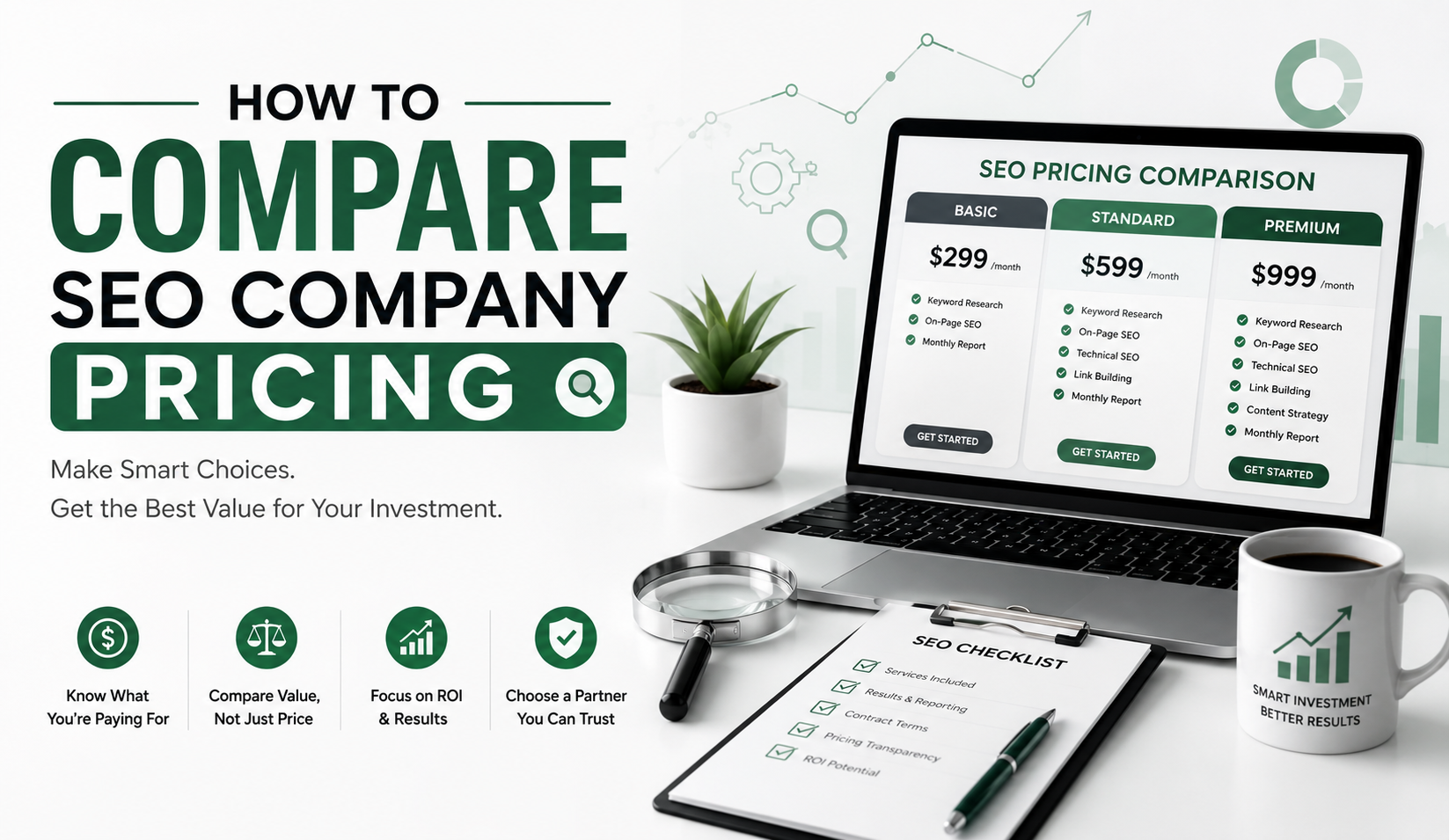
SEO company pricing for small businesses varies by scope, market competitiveness, and whether implementation is included in the fee. A narrow local SEO package costs less than a program that includes ongoing content production and link building. Price alone does not indicate quality; a company should explain what specific work justifies its pricing tier.
Small businesses working within a defined budget can review affordable SEO packages to compare scope at lower price points without eliminating core technical and reporting deliverables. A package priced significantly below market rate for the promised scope typically signals reduced implementation depth, outsourced work of inconsistent quality, or reporting that omits key metrics.
Industry-Specific vs. Generalist SEO Companies
SEO companies also differ by industry focus. An industry-specific SEO company works exclusively within one sector, such as healthcare, legal, or home services, and applies compliance knowledge and competitor data specific to that industry. A generalist SEO company serves businesses across multiple sectors and applies a broader, transferable methodology.
An industry-specific provider typically shortens the research phase of an engagement, since the company already understands the sector’s common keywords, seasonal demand patterns, and regulatory constraints. A generalist provider can still perform well for a small business, provided the company demonstrates a structured research process for unfamiliar industries during onboarding.
How AI Search Results Change SEO Company Evaluation
Search engines increasingly generate AI-driven summaries above traditional organic listings, which changes how a page needs to be structured to earn a citation. An SEO company evaluated for small business work should explain how it structures content for direct-answer visibility, including concise definitions near the top of a page, structured data markup, and clear entity relationships between topics.
A company that only discusses traditional keyword rankings, without addressing how content performs in AI-generated answers, may be applying an outdated evaluation framework. Ask any provider how its reporting accounts for visibility in AI search features, not only in the traditional ten blue links.
Questions to Ask Before Hiring an SEO Company
Ask each SEO company these seven questions during the evaluation process:
- What specific technical, content, and local SEO work happens in the first 90 days?
- Who performs the work: an in-house team, contractors, or a mix?
- Can you provide three verifiable case studies with before-and-after data?
- How is reporting structured, and which metrics are you accountable for?
- What is the average client tenure, and why do clients typically leave?
- How does the strategy change if the business adds a new location or service?
- What happens to completed work and site access if the contract ends?
A company’s answers to these questions reveal more about fit than a sales presentation. Vague answers to questions about implementation ownership or reporting typically indicate gaps in service delivery.
Red Flags When Choosing an SEO Company
Five warning signs indicate an SEO company may underperform for a small business:
- Guaranteed rankings on a fixed timeline. No company controls search engine algorithms directly.
- Unclear ownership of implementation. Some providers only supply recommendations without making site changes.
- Reporting limited to keyword rankings. Rankings alone do not confirm lead or revenue impact.
- Undisclosed link building methods. A company that cannot explain its link acquisition process risks penalty-triggering tactics.
- Long-term contracts with no defined milestones. A credible provider sets checkpoints to evaluate progress before renewal.
Frequently Asked Questions
What should I look for in an SEO company for my small business?
Look for verified case results, transparent reporting, and documented technical, content, and local SEO capability. A company that explains its process in specific terms is more reliable than one that relies on general marketing claims.
How do I verify an SEO company’s past results?
Request client references, before-and-after ranking or traffic data, and third-party review scores from platforms like Clutch or G2. Independent verification confirms claims made during the sales process.
Is a cheaper SEO company always a worse choice?
No, a lower price can be appropriate for a narrow local SEO scope, but the deliverables should still be clearly defined. Price becomes a risk factor only when it is paired with vague or unexplained scope.
Should a small business hire a local SEO specialist or a full-service agency?
A local SEO specialist fits a single-location business focused on map-pack visibility, while a full-service agency fits a business needing SEO alongside other marketing channels. The right choice depends on how many channels the business needs to manage.
How many SEO companies should I compare before choosing one?
Comparing at least three SEO companies against the same evaluation criteria produces a more reliable selection than evaluating a single proposal. A side-by-side comparison highlights differences in scope, pricing, and reporting that are easy to miss in isolation.
What is a reasonable contract length for small business SEO?
Most SEO engagements run in three- to six-month increments, with defined checkpoints to evaluate progress before renewal. A contract with no review milestones makes it harder to assess whether the engagement is working.
Can an SEO company guarantee first-page rankings?
No, no SEO company can guarantee a specific ranking position, since search engines weigh hundreds of ranking factors outside any provider’s direct control. A guarantee of this kind is a warning sign rather than a sign of confidence.
What Happens After You Choose an SEO Company
The first 30 days of an engagement typically include a technical audit, a Google Business Profile review, and a keyword research phase that maps target pages to search intent. The next 60 days usually shift toward implementation: technical fixes, content publishing, and initial link outreach. Reporting should begin from month one, even if ranking movement has not yet occurred, since early reports establish a baseline for traffic, rankings, and conversions.
A small business should expect an SEO company to revisit strategy at each reporting checkpoint rather than running an unchanged plan for the full contract term. Search results shift as competitors publish new content and as search engines update ranking algorithms, so a static strategy loses effectiveness over time.
Next Steps for Choosing an SEO Company
Compare SEO companies against the five criteria in this guide: local SEO execution, technical SEO depth, content and on-page work, transparent reporting, and documented case results. Request specific answers to the seven evaluation questions before signing a contract, and treat guaranteed rankings or vague deliverables as reasons to keep comparing options.