SEO Score Meaning: What Your Website Score Really Tells You
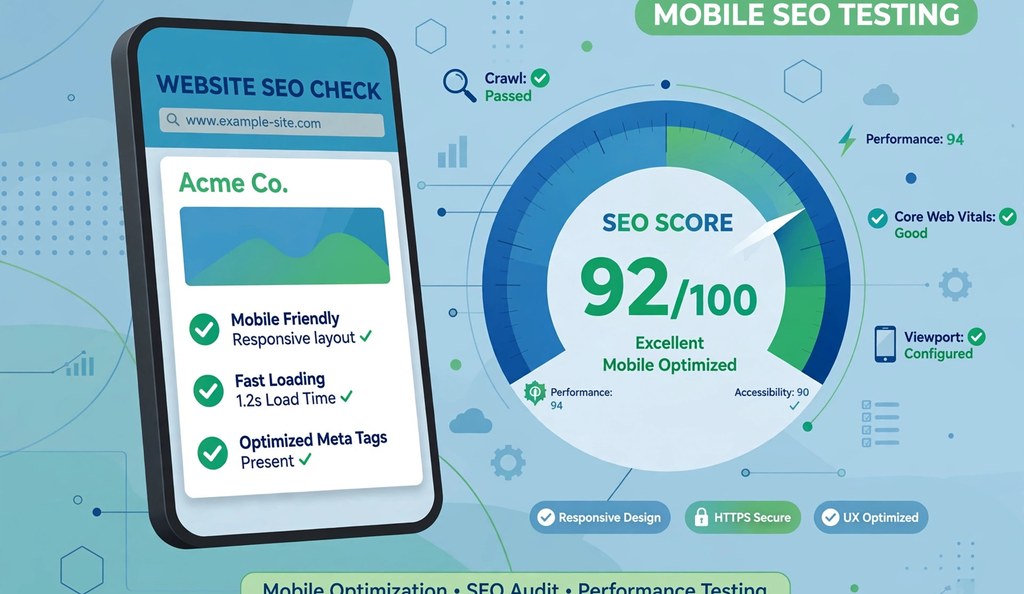
An SEO score is a number, usually from 0 to 100, that shows how well a website follows search engine optimization best practices. It is calculated by SEO tools, not by Google, and it summarizes things like on-page optimization, technical health, page speed, content quality, and backlinks into one easy grade.
If you have ever run a website audit and stared at a number like 73 out of 100, you are not alone. Most website owners see their score, feel confused, and ask the same question: what does this number actually mean, and should I worry about it? This guide breaks down the full SEO score meaning in plain language, shows you how the number is calculated, tells you what a good score looks like, and gives you a practical plan to raise yours.
What Does an SEO Score Mean, Exactly?
An SEO score is a single number that summarizes how optimized a webpage or website is for search engines. Think of it as a report card for your site’s technical and on-page health. A high score, such as 90 out of 100, means your page has very few fixable SEO issues. A low score, such as 40 out of 100, means significant problems are probably holding your visibility back.
Here is the part most people misunderstand: Google does not give out SEO scores. Every SEO score you see comes from a third-party tool such as Semrush, Ahrefs, Moz, Yoast, Ubersuggest, or a free website grader. Each tool crawls your page, runs its own set of checks, and combines the results into a number using its own weighting formula.
That is why the exact same page can score 85 in one tool and 68 in another. The underlying checks are similar across tools, but the way each tool weights them differs. A score is a useful compass, not a verdict handed down by Google.
How Is an SEO Score Calculated?
While every tool uses its own secret formula, the principles behind the calculation are remarkably consistent. An SEO score is built by checking dozens of individual factors, scoring each one, and blending the results into a weighted total. Factors that matter more for rankings usually carry more weight in the final number.
Most tools organize their checks into four or five broad categories. A common breakdown looks like this:
| Category | Typical Weight | What It Checks |
|---|---|---|
| On-page SEO | 25-30% | Title tags, meta descriptions, headings, keyword placement, URL structure |
| Technical SEO | 20-25% | Crawlability, indexation, HTTPS, sitemaps, robots.txt, structured data |
| Performance and UX | 20-25% | Page speed, Core Web Vitals, mobile friendliness, readability |
| Content quality | 15-20% | Word count, topic coverage, originality, internal linking |
| Authority signals | 10-20% | Backlink profile, referring domains, brand mentions |
Here is a simplified example of how the math works. A tool might check 50 individual items, award points for each pass, subtract points for each failure (with critical errors costing more than warnings), and then scale the result to a 0 to 100 range. A missing title tag might cost you 5 points, while a slow mobile page might cost 8, depending on the tool’s priorities.
Modern graders have also started adding smarter checks. Some tools now evaluate semantic relevance, which means they ask whether your content genuinely answers the searcher’s intent, not just whether the keyword appears a certain number of times. Freshness and originality of the information can play a role too.
The 5 Building Blocks of Your SEO Score
To understand your number, you need to know the ingredients that go into it. Let us walk through each building block and why it moves the needle.
1. On-Page SEO
On-page SEO covers everything visible on the page that helps search engines understand its topic. This includes your title tag, meta description, heading structure, keyword usage, image alt text, and URL. It usually carries the heaviest weight in an SEO score because these elements are fully in your control and strongly influence relevance.
When you run a free seo score check on any page, the on-page section is often where the quickest wins hide. A missing meta description or a duplicated title tag can drag the score down several points, and both are fixed in minutes.
2. Technical SEO
Technical SEO is about whether search engines can find, crawl, and index your pages at all. Checks include HTTPS security, XML sitemaps, robots.txt rules, canonical tags, broken links, redirect chains, and duplicate content. A page that Google cannot crawl will never rank, no matter how good its content is, so critical technical errors usually cost the most points.
This is also where checking a domain’s age and history can add useful context. Older domains are not automatically better, but a long, clean history often correlates with fewer technical surprises, while brand-new sites tend to trip more basic technical checks.
3. Page Speed and User Experience
Speed is a confirmed ranking factor and a major score component. Tools measure things like loading time, Core Web Vitals (Largest Contentful Paint, Interaction to Next Paint, and Cumulative Layout Shift), and mobile friendliness. A page that loads in under about two and a half seconds on mobile typically scores well here; one that takes six seconds will lose significant points.
User experience signals matter too. Readable text sizes, accessible contrast, tap targets that work on phones, and a layout that does not shift while loading all feed into this category.
4. Content Quality and Depth
Thin, shallow content scores poorly. Tools look at word count relative to the topic, whether headings cover the subject’s key subtopics, readability, and how well the page is internally linked to the rest of the site. Originality matters as well: pages that duplicate content from elsewhere get penalized in most scoring models.
A good rule of thumb is that content should fully answer the question the searcher typed. If someone searches for the SEO score meaning, a page that defines it, explains the calculation, shows score ranges, and answers follow-up questions will score far better than a page with two vague paragraphs.
5. Backlinks and Authority
Off-page signals round out the score. Tools examine the number and quality of backlinks pointing to the page and domain, referring domain diversity, and sometimes brand mentions. A handful of links from respected sites outweighs hundreds of low-quality ones, so authority scoring focuses on quality over quantity.
Note that page-level SEO scores often emphasize on-page factors more than authority, while domain-level scores weigh the backlink profile more heavily. Knowing which one you are looking at helps you read the number correctly.

What Is a Good SEO Score?
Most tools use a 0 to 100 scale, and the interpretation bands are fairly standard across the industry:
| Score Range | Rating | What It Means |
|---|---|---|
| 90-100 | Excellent | Near-perfect optimization. Remaining gaps are minor. Focus on content and authority, not fixes. |
| 80-89 | Very good | Well optimized with a few clear improvement opportunities. |
| 70-79 | Good | Solid foundation. Shift effort toward content depth and internal linking. |
| 50-69 | Average | Significant room for improvement. Most small business sites land here. |
| 0-49 | Poor | Multiple critical issues that are likely suppressing rankings. Fix failures first. |
As a general benchmark, aim for 80 or above. That range tells you the technical and on-page basics are in good shape. Chasing a perfect 100 is usually not worth it: the last few points often require changes that make the page worse for real readers, like stuffing keywords into places where they do not belong.
Context matters as well. What counts as good depends on your niche and your competition. If every competitor in your space scores in the 60s, reaching the mid 70s can be enough to stand out. The smartest use of the score is as a personal benchmark: record it, fix issues, and watch it climb over time.
Why Your Score Differs Between Tools
It is completely normal for the same URL to earn different scores in different tools. A page might score 82 in a free seo page checker, 76 in a premium site audit, and 90 in a WordPress plugin. None of them is lying. They simply check different things and weight them differently.
Common reasons for the differences include:
- Different checklists: one tool tests 40 factors, another tests 120. More checks means more chances to lose points.
- Different weights: a tool built for bloggers may weight content heavily, while a technical audit tool may punish slow speed harder.
- Page vs. domain scope: some tools score a single page, others average across the whole site.
- Crawl timing: scores are snapshots. A tool that crawled your site before yesterday’s fix will show the old number.
Because of this, pick one tool as your reference and track your progress with it over time. Comparing scores across tools is like comparing temperatures in Celsius and Fahrenheit: the numbers differ, but both describe the same weather.
SEO Score vs. Actual Rankings: What the Number Cannot Tell You
This is the most important section of this guide, so read it carefully. An SEO score is not a ranking, and raising your score does not automatically raise your rankings. Google has repeatedly said it does not use a single site-wide “SEO score” in its ranking systems. What it ranks is pages, based on hundreds of signals, for specific queries.
A page scoring 95 can still be outranked by a page scoring 70. How? The lower-scoring page might have stronger backlinks, better topical authority, fresher information, or content that simply matches the searcher’s intent more closely. The score measures how well you follow optimization best practices. Rankings measure how well you satisfy a specific search.
Think of the score like a car’s inspection report. A perfect inspection does not guarantee you win the race, but a car with failing brakes will not finish it either. A low SEO score is almost always a drag on rankings because it means real technical problems are in the way. A high score clears the path so that your content and authority can do their work.
That is also why you should check seo ranking positions alongside your score, not instead of it. The score tells you what to fix. The rankings tell you whether the fixes are working.
How to Improve Your SEO Score: A Practical Plan
Raising your score is straightforward once you know which levers to pull. Work through these steps in order, because the early ones fix the costliest problems first.
Fix critical technical errors
Start with anything marked critical or as an error rather than a warning. Common culprits include pages blocked by robots.txt by accident, missing HTTPS, broken internal links, and redirect chains. These fixes are usually quick and each one can lift the score noticeably.
Write complete title tags and meta descriptions
Every important page needs a unique title tag of roughly 50 to 60 characters and a meta description of roughly 150 to 160 characters. Put the primary keyword near the start of the title, and write the description as a mini advertisement that earns the click. Missing or duplicated meta tags are among the most common score killers.
Speed up the page
Compress images, enable caching, remove unused scripts, and use a fast, reliable host. Test with a speed tool, fix the biggest offenders first, and re-check your score. Even a one-second improvement can move the needle.
Strengthen headings and content structure
Use one clear H1 per page, organize subtopics with H2s and H3s, and make sure your target keyword appears naturally in the title, the first hundred words, and at least one heading. Break long walls of text into short paragraphs and lists so readers, and crawlers, can scan easily.
Add internal links
Link related pages together with descriptive anchor text. Internal links help search engines discover content, spread authority across your site, and keep visitors reading longer. Most pages should have at least a few contextual internal links pointing in and out.
Build quality backlinks over time
Authority is the slowest lever but one of the most powerful. Earn links by publishing genuinely useful content, doing original research, and building real relationships in your niche. One link from a respected site in your industry can matter more than fifty low-quality ones.

People Also Ask: Quick Answers About SEO Scores
Does Google use SEO scores to rank websites?
No. Google does not calculate or use a single SEO score. Scores come from third-party SEO tools. Google ranks pages using its own complex systems, and while many scored factors overlap with real ranking signals, the number itself is not something Google sees.
Can a website rank well with a low SEO score?
Yes, it happens, but it is an uphill battle. A page with exceptional content and strong backlinks can outrank better-optimized competitors for some queries. Still, a low score means fixable problems are dragging the page down, so fixing them is almost always worthwhile.
How often should I check my SEO score?
Monthly is a good rhythm for most sites, plus a check after any major change. Track the trend rather than obsessing over day-to-day movement. A steady climb over three to six months is the sign of a healthy optimization routine.
Is a 100 SEO score possible?
Technically yes, but it is rarely worth chasing. Perfect scores usually require sacrificing natural writing for checklist compliance. Most professionals consider the mid 80s to low 90s the practical sweet spot, then shift effort to content quality and link building.
Frequently Asked Questions
What is an SEO score in simple terms?
An SEO score is a 0 to 100 grade showing how well a page follows SEO best practices. Higher means fewer fixable issues and a healthier page from a search engine’s point of view.
What does SEO score mean for my rankings?
It means your page’s technical and on-page readiness, not a ranking guarantee. A high score removes obstacles to ranking, while a low score usually indicates problems that are actively suppressing visibility.
Who calculates SEO scores?
Third-party SEO tools calculate them, not Google. Popular sources include Semrush, Ahrefs, Moz, Yoast, Ubersuggest, and free online graders. Each uses its own formula.
What is a good SEO score for a new website?
Anything above 70 is a strong start for a new site. New websites often score in the 50s or 60s because they lack backlinks and indexed history. Fix on-page and technical issues first, and the number will climb as the site matures.
What is a bad SEO score?
Below 50 is generally considered poor. Scores in this range point to multiple critical issues such as slow loading, missing meta tags, crawl errors, or no mobile optimization, and they usually correlate with weak search visibility.
How is an SEO score calculated?
Tools crawl the page, test dozens of factors, and combine weighted results into one number. On-page elements, technical health, speed, content quality, and backlinks each contribute a share, with critical errors costing more points than minor warnings.
Why did my SEO score drop suddenly?
A sudden drop usually means something changed on the page or in the tool. Common causes include a redesign that broke meta tags, new render-blocking scripts slowing the page, lost backlinks, or the tool updating its scoring formula. Compare the detailed report before and after to find the culprit.
Do backlinks affect my SEO score?
Yes, in most scoring models they do. The quantity and especially the quality of backlinks feed the authority portion of the score. A page with strong, relevant backlinks will generally score higher than an otherwise identical page with none.
Does domain age affect SEO score?
Not directly, but it correlates with factors that do. Older domains tend to have more backlinks and indexed history, which helps. You can check domain age to understand a site’s history, and read about whether domain age affects SEO to see how age interacts with rankings.
Can I improve my SEO score for free?
Yes. Most high-impact fixes cost nothing but time. Writing proper titles and descriptions, compressing images, fixing broken links, improving headings, and adding internal links are all free, and free audit tools will verify the improvement.
How long does it take to raise an SEO score?
Technical fixes can lift a score within days of recrawling. Authority-related gains take longer, often several months, because they depend on earning backlinks and building content depth. Track the trend monthly rather than daily.
Should I trust a free SEO score checker?
Yes, as a starting point. Free checkers reliably catch the basics: missing tags, slow pages, broken links, and thin content. Use them for routine monitoring, and consider premium tools when you need deeper competitive or backlink analysis.
What matters more: SEO score or content quality?
Content quality matters more for actual rankings. The score is a diagnostic tool that tells you what is broken. Great content with a mediocre score can still rank, while a perfect score cannot save thin, unhelpful content. Fix the score, then invest in being genuinely useful.
Conclusion: Use Your Score as a Compass, Not a Destination
The SEO score meaning is simpler than the industry sometimes makes it sound: it is a health check for your website’s optimization, calculated by tools that grade how well you follow proven best practices. Aim for 80 or above, fix the critical issues first, track your progress with one consistent tool, and remember that the number serves your rankings, not the other way around. If you want the full picture of how search optimization works, from crawling to ranking, the Wikipedia article on search engine optimization is a solid place to continue learning.